An alternative direction to the gang idea. Instead of making pesticides the villain, we make Honest Farms' obsession with pesticide-free food the joke everyone wants to share. Brand-positive, FSSAI-safe, and built to travel.
The earlier idea made pesticides the character — a hidden gang spraying your food. That premise is exactly what set off the legal concern in the room: it implies other food is poisoned, which is FSSAI-sensitive and reads as a dig at competitors. So we flipped it.
Fear-led. Implies rival food is unsafe. Hard to defend if FSSAI or a competitor pushes back, because the whole joke depends on other food being dirty.
Comedy-led. We laugh at how absurdly thorough Honest Farms is about its 230+ pesticide-free checks. The joke is always on us, so there is nothing to defend against.
AI reference · hover to play
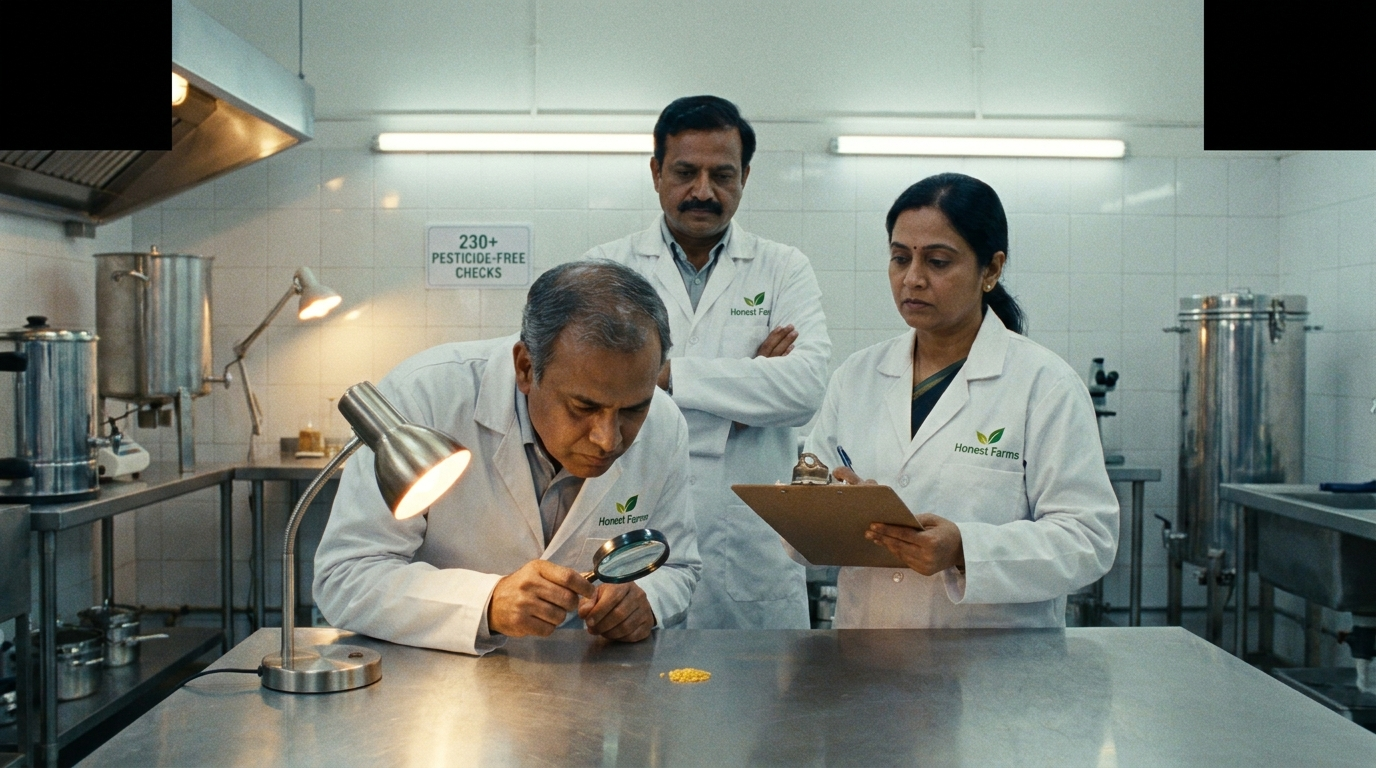
A mockumentary set inside the Honest Farms quality lab, where a team of lovably obsessive inspectors run all 230 pesticide-free checks and still can't sleep. Every film is them inventing a ridiculous 231st check.
Interrogating a moong dal under a desk lamp. Sending the rice to therapy. A trust-fall with a jar of ghee. A lie-detector strapped to a chickpea.
Every home has the person who over-checks everything — the uncle who tests the gas knob four times. We made him the entire QC department.
Deadpan, infinitely repeatable, and a built-in reply prompt: "suggest our 231st check."
The 230 checks are the pesticide-free checks. The 231st is the joke that proves we'd rather over-test than let anything through.
Unbranded clips of a single lentil being interrogated.
It's the Honest Farms pesticide-free lab. The obsession has a home.
The same characters explain what the checks actually screen for.
AI reference · hover to play
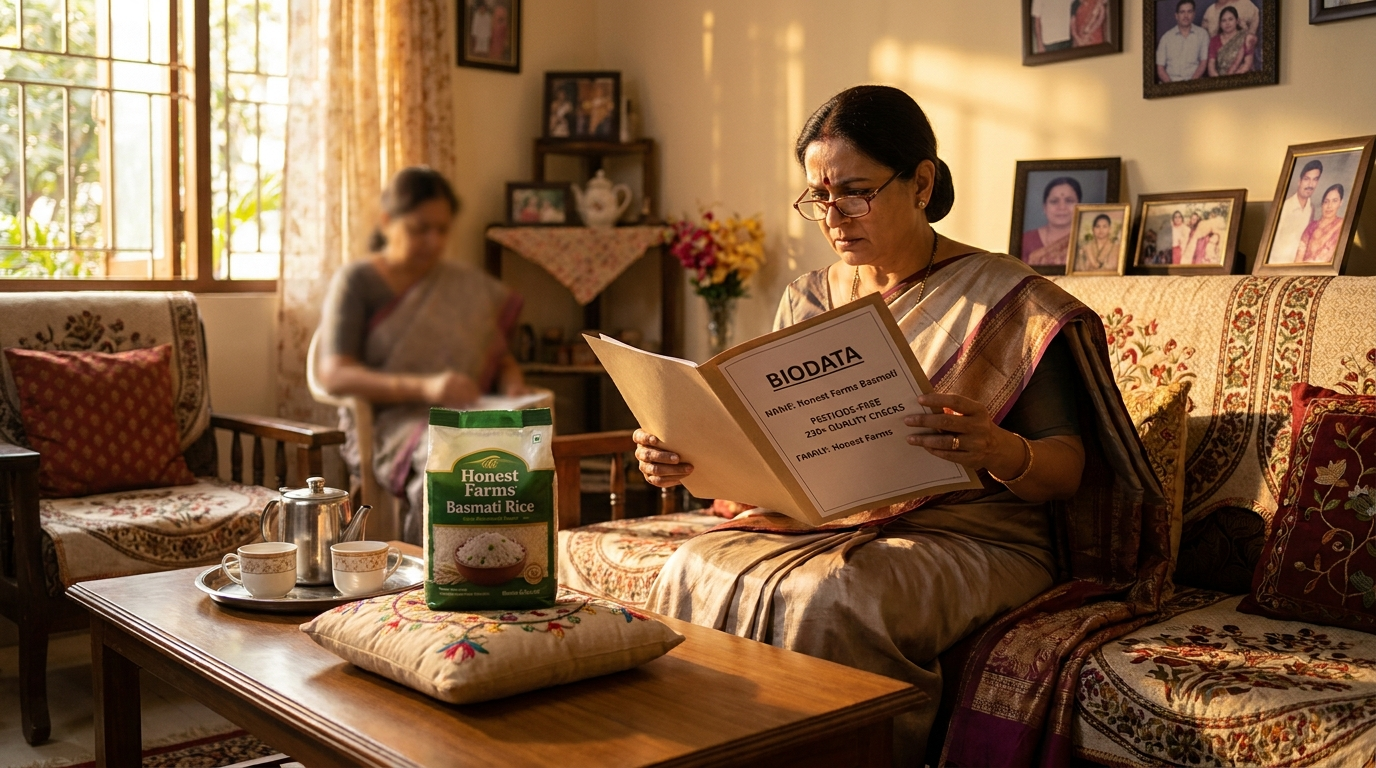
A parody of Indian matchmaking. Honest Farms vets every grain like a prospective bahu or damaad — biodata, family background, a 230-point character check — before it earns a place in your kitchen.
A rishta-aunty inspects the dal, glasses down her nose, and finally gives her approval. Only then is it marriage material.
Families run deeper background checks on a rishta than on almost anything. We apply that same scrutiny to food.
Rishta-aunty and Indian Matchmaking culture is instant share-bait and endlessly quotable.
It stays about vetting our own food. We never rate other brands as bad matches — the comedy is the over-the-top vetting.
A rishta-aunty seriously vetting a packet of grain. No brand yet.
The biodata is the 230 pesticide-free checks.
The checklist read out, line by line.
AI reference · hover to play
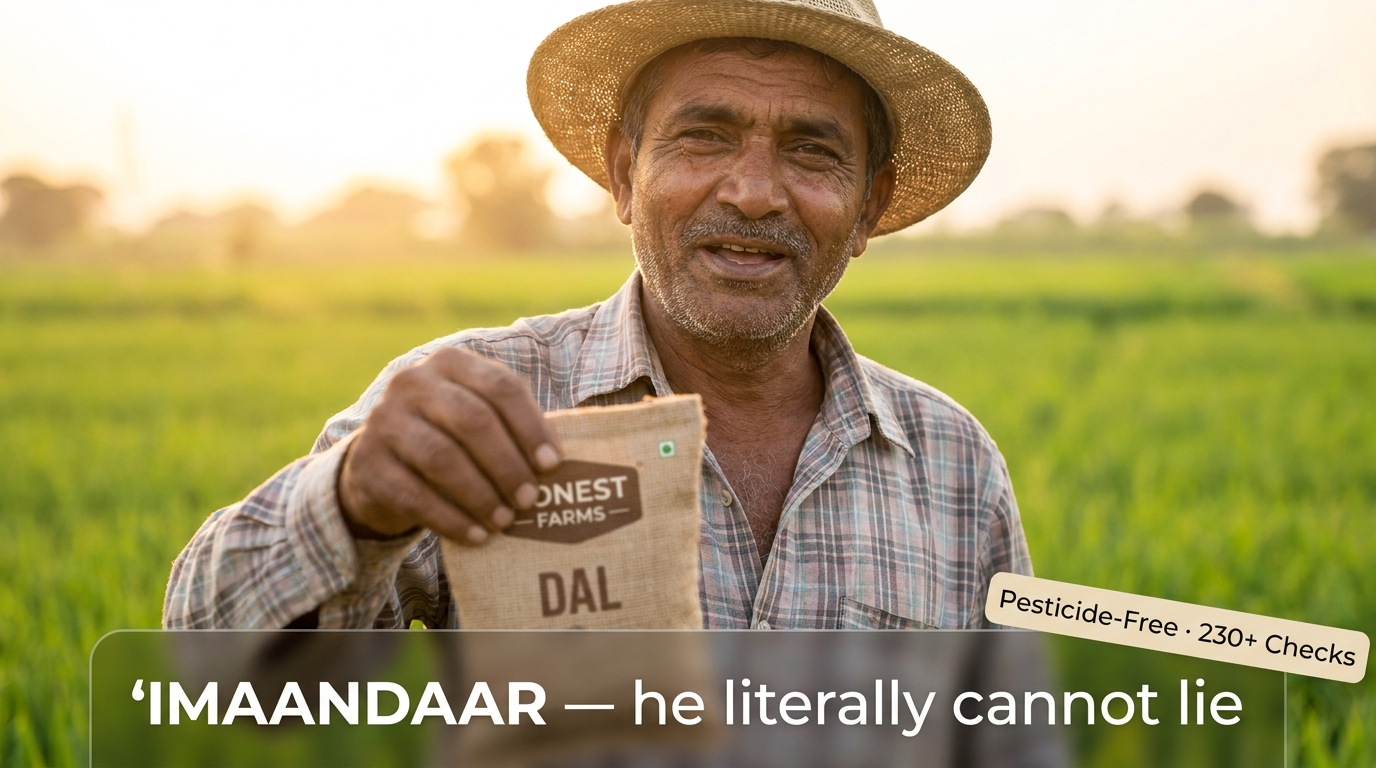
A brand mascot — a farmer-uncle who is congenitally incapable of dishonesty. Ask him anything and he over-discloses: which field, which farmer, the exact 230 pesticide-free checks, even the one time a batch didn't pass.
His radical honesty turns ordinary situations into comedy, and gives the brand a face people quote.
The brand is literally called Honest Farms. We give "honest" a face who takes it too far.
A repeatable mascot plus a catchphrase builds long-term equity, not just a one-off campaign.
His honesty is the proof — he'll tell you everything, including that there are zero pesticides and exactly how we know.
Short clips of a man over-sharing inconvenient truths.
He's Honest Farms. Honesty is the whole point.
The long-form / podcast piece, told by a credible face.
Each idea is brand-safe and pesticide-free first. Side by side, they map onto the tease → reveal → educate arc the brief already called for.
The pure-virality content engine that fills the feed during the tease phase.
The cultural share-bait that carries the brand reveal into everyday conversation.
The long-term brand asset that owns the educate phase and the podcast seat.